

Embedded World India
embedded world India brings the embedded systems community to Bengaluru for an exhibition and technical conference covering components, software, connectivity, and intelligent devices. Its first edition takes place alongside Bengaluru Tech Summit, connecting specialists in embedded design with India’s wider technology ecosystem.
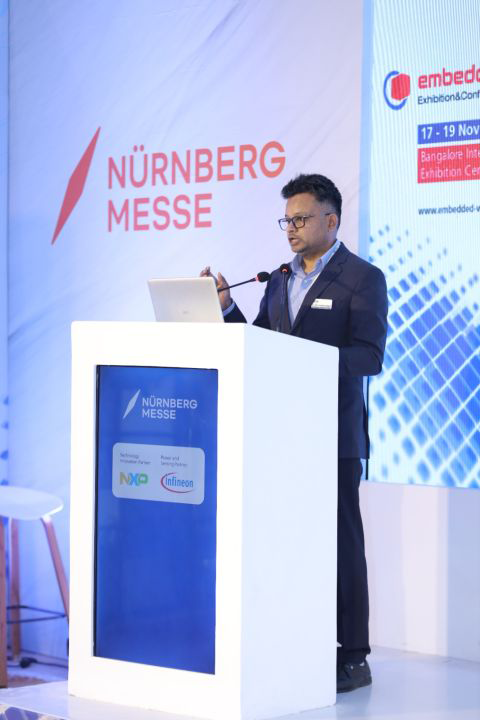
For developers of industrial controllers, connected infrastructure, and other long-lived devices, an embedded product must remain secure well beyond its initial release. That raises a difficult question: how can a device designed around limited memory, processing power, and connectivity adapt as cryptographic requirements change? Wibu-Systems will explore this challenge in a conference talk presented by Dr. Ashok Chandra-Sekaran, Managing Director of WIBU-SYSTEMS India Pvt. Ltd.
India’s Embedded Technology Outlook
India’s embedded sector is developing within a larger industrial and technology partnership. At the third EU-India Trade and Technology Council in July 2026, India and the EU agreed to intensify cooperation in semiconductors, electronics, AI, quantum technologies, 6G, and strategic value chains. As more connected equipment moves from development into long-term use and critical infrastructure, protecting its software and planning for future cryptographic changes will become increasingly relevant, even for devices with little memory, limited processing power, or no direct Internet connection.
Securing India’s Embedded Future
Conference talk: Securing India’s Embedded Future: Post-Quantum Cryptography for Long-Term Product Security
 19 November 2026
 1:25 pm
Industrial controllers, smart-city infrastructure, and IoT devices can remain in service for 10 to 20 years. During that time, the cryptography protecting their communications, software, and credentials may need to change. The risk includes Harvest Now, Decrypt Later attacks, in which encrypted information captured today could be decrypted when sufficiently capable quantum computers become available. For manufacturers, the challenge is especially acute when deployed devices have limited memory and processing power, no direct Internet access, and no TLS stack.
Dr. Chandra-Sekaran will examine what post-quantum migration means for these existing products. He will introduce ML-KEM (FIPS 203) and ML-DSA (FIPS 204) and discuss the implementation trade-offs they present in resource-constrained environments. The central question is how to make a long-lived device cryptographically adaptable without requiring a complete hardware redesign.
The talk will then present an edge-based migration architecture: a server on the local network supplies licenses and cryptographic material to microcontrollers, drawing on local containers or cloud-backed resources according to the deployment. This approach also accommodates critical environments that must operate fully offline. The underlying mechanism for delivering licenses to microcontrollers without their own Internet connection or TLS stack has already been demonstrated in a live secure-shopfloor setting; the session explores how to extend that foundation into a post-quantum migration strategy.
Participants will leave with a practical framework for planning brownfield upgrades, including cryptographic inventories and CBOMs (Cryptographic Bills of Materials). The session will relate that work to India’s National Quantum Mission roadmap, which sets a foundations milestone for critical information infrastructure by 2027 and a full migration target by 2029, and will consider relevant Indian testing and certification frameworks alongside the EU Cyber Resilience Act.
Security and Licensing for Small Devices
Wibu-Systems’ embedded portfolio addresses a broad range of hardware, from industrial computers to microcontrollers with very limited resources. CodeMeter Embedded, CmASIC, and a compact microcontroller library provide options for integrating licensing into smaller devices. An optimized license format and activation workflows help keep demands on memory, storage, and processing power low while connecting those devices to a wider license management infrastructure.
This combination matters when manufacturers want to protect valuable firmware, activate product features, or maintain control over licensed functions after deployment. It also puts the post-quantum discussion in a practical setting: a migration strategy must fit the capabilities and expected lifetime of the devices it is meant to secure.
Now in its first year, WIBU-SYSTEMS India is actively engaging with the country’s embedded technology community. The talk brings together the local team’s perspective on Indian applications and Wibu-Systems’ experience in protecting and licensing software across device classes.